



Medically Reviewed by Dr. Hollander on September 28, 2026
If your child has struggled with breastfeeding, speech, or eating in ways that other explanations haven’t fully accounted for, a restricted frenulum may be worth looking into. Children with tongue-tie or lip-tie often show signs from infancy onward. A baby who can’t latch well, a toddler who drops certain sounds, a school-age child who avoids certain textures at the dinner table may all be showing early indicators of a restricted frenulum. For many of these kids, a frenectomy evaluation is a reasonable next step, and catching it sooner rather than later tends to make treatment simpler.
At Pediatric Dentistry of San Jose, our team has spent decades caring for children in the Alum Rock community and across the greater San Jose area. For families wondering whether a frenectomy may be right for their child, our tongue-tie treatment page is a helpful starting point, and our providers offer thorough evaluations to determine whether treatment is the right path forward.
What Are Tongue-Tie and Lip-Tie?
The frenulum is a small band of tissue that connects two parts of the mouth. The tongue attaches to the underside of the floor of the mouth. The upper lip connects the lip to the gum above the front teeth. When these bands are unusually thick, short, or tight, they restrict normal movement. Tongue-tie (ankyloglossia) limits how far the tongue can move, while lip-tie affects how freely the upper lip can lift and flange outward.
Both conditions exist on a spectrum. Some children have minor restrictions with no noticeable symptoms, while others experience significant difficulty with feeding, speech, or oral function. The American Academy of Pediatric Dentistry’s policy on frenulum management recognizes that evaluation should be individualized, taking into account the child’s age, symptoms, and overall development rather than relying on appearance alone.
Signs Your Child May Have a Restricted Frenulum
Symptoms vary depending on the child’s age. Infants often show feeding-related signs, while older children may present with speech or dental concerns. Because the effects shift as children grow, many families don’t connect early feeding struggles to later developmental challenges.
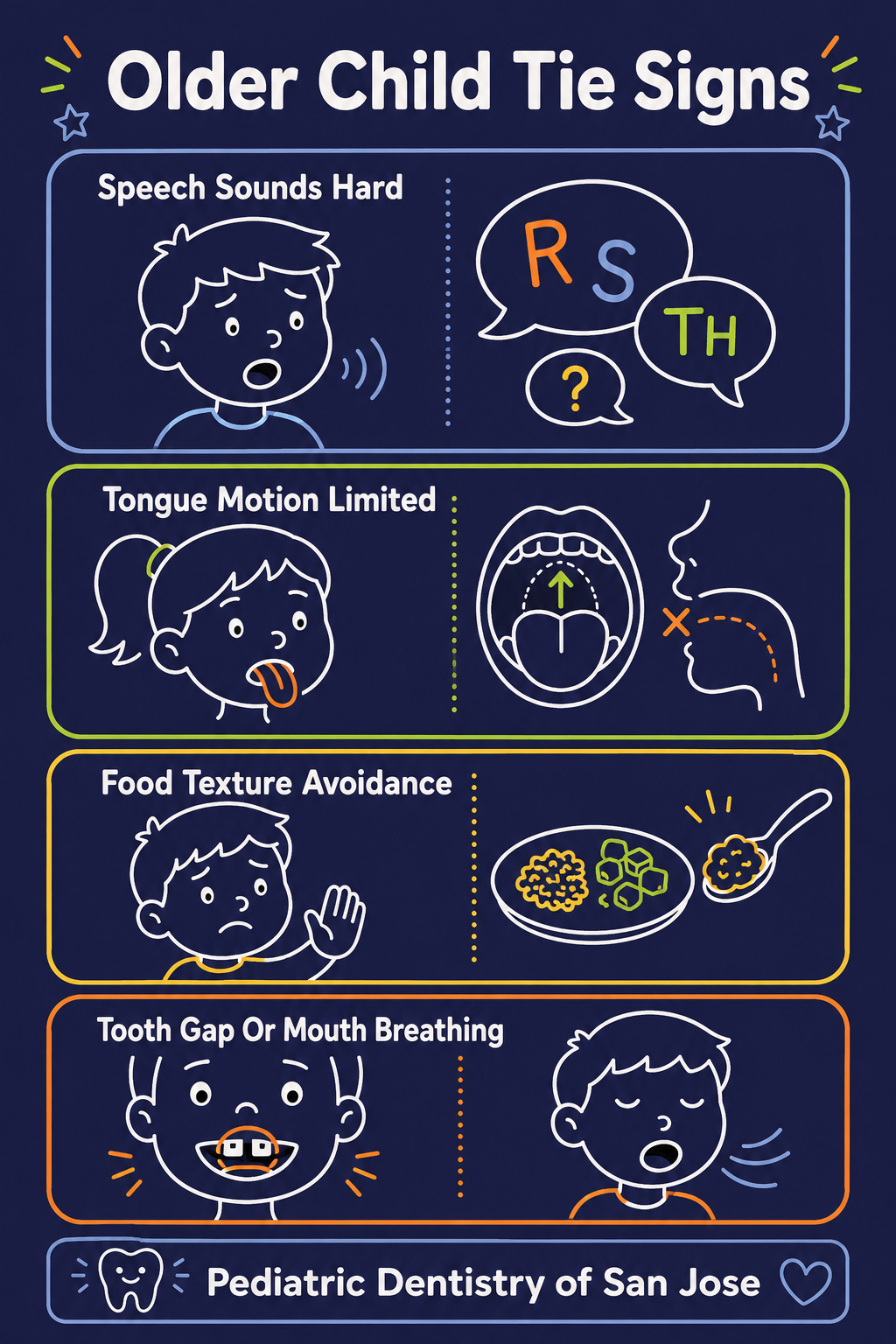
Common signs worth discussing with a provider include the following. In infants, it might be difficulty latching or slipping off the breast, clicking sounds during feeding, poor weight gain, and excessive gas or fussiness after feeding. In toddlers and older children, symptoms may include the following:
- Trouble with sounds: Difficulty pronouncing certain sounds, particularly “t,” “d,” “l,” “r,” “s,” or “z”.
- Limited tongue movement: Trouble licking lips or moving the tongue to the roof of the mouth.
- Food aversions: Discomfort or avoidance of certain textures or foods.
- Visible gap: A space between the two upper front teeth caused by a tight lip frenulum.
- Breathing patterns: Mouth breathing or difficulty closing the lips comfortably at rest.
No single sign is definitive on its own, which is why a full clinical evaluation matters. A provider experienced with these conditions can assess function and mobility rather than relying only on how the frenulum looks.
How a Frenectomy Works and What Laser Technology Changes
When a restricted frenulum is identified and treatment is recommended, the procedure used to release it is called a frenectomy. How it is performed, and what tools are used, make a meaningful difference in the child’s experience and recovery.
The Procedure Itself
A frenectomy releases the restricted frenulum tissue to restore the normal range of motion so that feeding, speech, and oral function can develop without the structural limitation. When caught early in infancy, the procedure is typically brief and straightforward. For older children, the process involves more preparation, including a discussion of what to expect and, when appropriate, sedation options to keep them comfortable throughout the procedure.
Why Laser Makes a Difference
Our practice uses laser dentistry for frenectomy procedures rather than traditional scissors or scalpel techniques. Laser treatment can be especially helpful for young patients because it cauterizes as it works, which means minimal bleeding, a lower risk of post-procedure infection, and often less discomfort with faster healing compared to conventional methods. For families who are already nervous about a child’s procedure, those details can make the appointment feel more manageable and help the recovery go more smoothly.
What to Expect After Treatment
Recovery from a laser frenectomy is generally quick. Most children return to normal activity within a day or two. Providers typically recommend a series of stretching exercises after the procedure to prevent reattachment of the tissue and to help the child build new muscle patterns. For infants, this often happens in coordination with a lactation consultant or feeding therapist. For older children working through speech concerns, continuing with a speech-language pathologist after the procedure gives the best long-term results.
It is worth noting that a frenectomy is not always the first or only answer. Our providers take a thorough approach to evaluation, factoring in whether the child’s symptoms are truly functional in origin and whether other support, such as sedation dentistry for anxious patients, may also be appropriate. Families with children who have additional sensory or health needs can also learn more about our approach to pediatric special needs care.
Find Out if Your Child Is a Candidate at Pediatric Dentistry of San Jose
Our practice has served East San Jose families for over 40 years, and our team brings board-certified pediatric training and advanced laser technology to every evaluation. If your child is showing signs of a restricted frenulum, whether as a newborn struggling to feed or an older child with persistent speech concerns, we are here to help you sort through the options with clarity and care. Regular pediatric exams and cleanings also give our providers an ongoing opportunity to monitor oral development and flag concerns early.
You do not have to wait and wonder. Reach out to our team and let us take a closer look. Request an appointment online to get started.
Frequently Asked Questions About Frenectomy for Children
At what age can a frenectomy be performed on a child?
A frenectomy can be performed at virtually any age, from newborns to older children and adults. For infants experiencing significant difficulty with breastfeeding, the procedure is often recommended as early as the first few days or weeks of life because the benefits for feeding can be immediate. For older children whose tongue-tie or lip-tie is affecting speech, oral function, or dental development, the procedure is typically performed once the concern has been clinically evaluated and the timing makes sense in the context of the child’s overall development.
Will my child need to go under general anesthesia for a frenectomy?
For most older children, a laser frenectomy is performed using local anesthetic rather than general anesthesia. Laser treatment minimizes bleeding and discomfort compared to traditional methods, which allows the procedure to be completed quickly and comfortably with a topical numbing agent and local anesthesia in most cases. For younger infants, the procedure is often brief enough that no anesthesia is needed at all. For children with significant anxiety or additional sensory or health needs, sedation options can be discussed during the evaluation appointment.
How do I know if my child’s feeding or speech issues are caused by tongue-tie and not something else?
Tongue-tie and lip-tie exist on a spectrum, and the symptoms they cause can overlap with other developmental concerns. A clinical evaluation is the most reliable way to determine whether a restricted frenulum is contributing to the problems your child is experiencing. Our providers assess tongue and lip mobility directly rather than relying solely on appearance, because the degree of restriction matters as much as how the frenulum looks. If another cause is more likely, we will say so and discuss appropriate next steps.
What is recovery like after a laser frenectomy for a child?
Recovery from a laser frenectomy is generally quick. Most children return to normal activity within a day or two, and the reduced bleeding associated with laser technique means less discomfort and a lower risk of post-procedure infection compared to traditional methods. Providers typically recommend a series of gentle stretching exercises in the days and weeks after the procedure to prevent reattachment and help the child build new muscle movement patterns. For infants, this often happens alongside support from a lactation consultant or feeding therapist.
Does tongue-tie reattach after a frenectomy, and how do the stretching exercises help?
Reattachment is possible if the tissue heals back together during the recovery period, which is why providers recommend stretching exercises after the procedure. The exercises are designed to keep the release site open and mobile as it heals, encouraging the area to form in a way that preserves the full range of motion rather than tightening back down. For older children working on speech, exercises may also include specific tongue movements that help establish new muscle patterns now that the structural restriction has been removed. Our team provides guidance on the exercises at the post-procedure visit.
ABOUT THE AUTHOR
Diplomate, American Board of Orthodontics — Pediatric Dentistry of San Jose, San Jose, CA
Dr. Hollander is a Diplomate of the American Board of Orthodontics and holds a master’s degree in Oral Biology from UCLA. As the in-house orthodontist at Pediatric Dentistry of San Jose, he brings specialized training and a collaborative approach to every evaluation and treatment plan he develops for young patients.