



Medically Reviewed by Dr. Hollander on September 28, 2026
Your child’s dentist says “palate expander,” and suddenly you have a hundred questions. What does it do? Does it hurt? Is your child really old enough for this? For many San Jose families, the recommendation catches them off guard, and the unfamiliarity alone can make an otherwise routine treatment feel overwhelming.
At Pediatric Dentistry of San Jose, our team helps families in the East San Jose area understand every step of their child’s orthodontic process. With board-certified pediatric dentists and an on-site orthodontist, our practice is equipped to help families understand what palate expander treatment involves and when it may be recommended. Dr. Zachary Hollander is a Diplomate of the American Board of Orthodontics and has published in the American Journal of Orthodontics and Dentofacial Orthopedics on maxillary skeletal expansion, giving families added confidence when expansion is part of the conversation.
What Is a Palate Expander?
A palate expander is a custom-fitted orthodontic appliance that sits across the roof of the mouth and attaches to the upper back teeth. Its job is to gradually widen the upper jaw by applying gentle, consistent pressure to encourage new bone growth between the two halves of the palate. Because children’s jaws are still developing, this process is far more effective in younger patients than in adults, whose jaw bones are already fused.
The American Association of Orthodontists notes that palate expanders are most commonly used to treat growing children and young teenagers. Appropriate timing can, in some cases, help avoid tooth extraction, impacted teeth, or more invasive treatment down the road. This is one reason why routine orthodontic evaluations before age seven are so valuable, and why our early orthodontic services are built around catching these issues at the right time.
Why Might Your Child Need One?
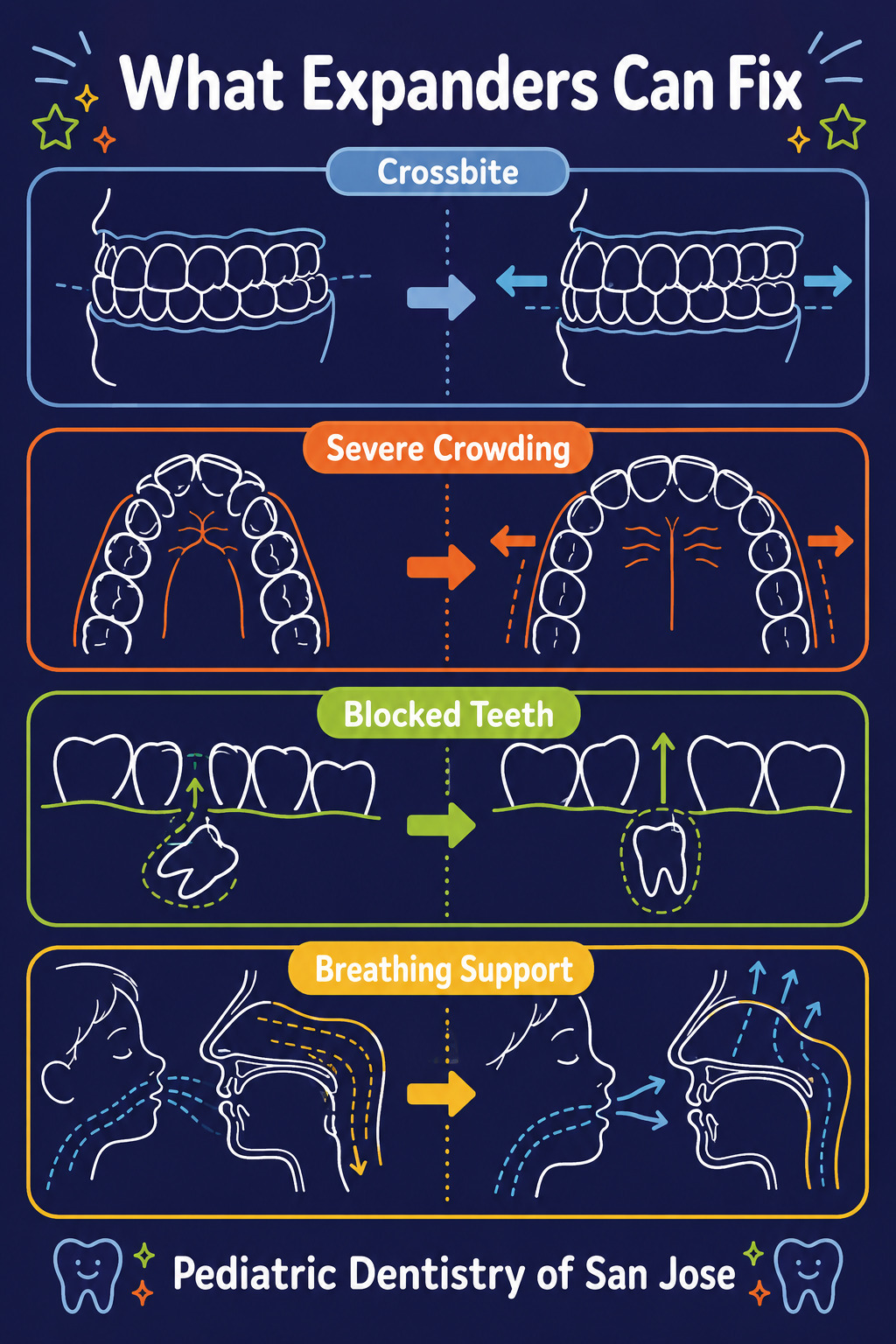
There are several reasons an orthodontist might recommend a palate expander. The most common involve bite problems and jaw development, and each one is worth knowing about before treatment begins.
The conditions that palate expanders are most often used to address include:
- Crossbite: When upper teeth sit inside the lower teeth when biting down, an expander corrects the underlying bone width to prevent uneven wear and jaw asymmetry.
- Severe crowding: A narrow upper jaw leaves little room for permanent teeth to come in properly, and widening the arch creates the space needed.
- Impacted teeth: When the jaw is too narrow, incoming teeth can get blocked, and expansion helps clear the path.
- Breathing concerns: In some children, widening the palate can improve nasal airflow by opening the nasal floor.
Knowing why your child’s provider is recommending the treatment goes a long way toward helping you feel confident in the decision. Our article on interceptive orthodontics for children explains how early intervention fits into a broader treatment plan.
What the Treatment Process Looks Like
Palate expander treatment moves through several distinct phases, and knowing what each one involves helps you and your child feel prepared from the very first appointment.
The Initial Evaluation and Placement
Before any appliance is placed, your child’s orthodontist will evaluate jaw width, bite alignment, and skeletal maturity to confirm that an expander is appropriate. A custom device is then fabricated and fitted to the upper back teeth, either fixed in place or removable, depending on the case. Fixed expanders are the most common for younger children because compliance is built in.
Adjustment and Monitoring
Most fixed expanders are widened incrementally with a small key, following a schedule your provider will give you. Each adjustment applies gentle pressure that separates the two halves of the palate, stimulating new bone formation as they gradually move apart. Regular check-in visits allow the orthodontist to track progress and ensure the teeth and gums remain healthy throughout treatment. You may notice a small gap forming between the upper front teeth during this phase — this is normal and closes on its own as bone fills in.
Retention and Next Steps
Once the jaw reaches the desired width, the expander typically stays in place for several months to allow the new bone to stabilize. From there, the next phase of orthodontic treatment, often involving braces or aligners, addresses any remaining tooth alignment issues. Families often wonder how this fits into the bigger picture, and our article on whether your child needs early orthodontics covers that timeline in detail.
What to Expect at Home
Most children adjust to a palate expander within a week or two. Some initial pressure or mild soreness is normal after adjustments, and speech may sound slightly different for the first few days. Encouraging your child to practice speaking out loud can speed up that adjustment period considerably.
Food choices matter during treatment. Sticky, chewy, or hard foods can damage the appliance or dislodge it, so softer meals are the way to go in the early weeks. Thorough brushing around the expander after every meal is important, and a water flosser can be a helpful addition to your child’s routine. Our team also addresses common questions like these during visits, and our article on child orthodontic evaluation offers additional context on what these appointments involve.
Frequently Asked Questions About Palate Expanders
Here are the questions parents most often ask before and during palate expander treatment.
Do palate expanders hurt?
Most children experience some pressure or mild discomfort after each adjustment, but not pain. The feeling is often described as a temporary tightness that settles within a day or two. Soreness at the roof of the mouth or around the back teeth is common in the first week, and over-the-counter pain relievers can help if needed. The discomfort tends to decrease as the child adapts to the appliance.
How long does palate expansion treatment take?
The active expansion phase typically lasts a few months, during which the jaw is gradually widened. After expansion is complete, the expander usually stays in place for an additional four to six months to allow new bone to form and stabilize. Total treatment time varies depending on the amount of expansion needed and how quickly the child’s bone responds.
Will my child need braces after the palate expander?
Many children do continue with braces or aligners after palate expansion, since expansion addresses jaw width but not the final positions of individual teeth. In some cases, Phase 1 treatment — which includes expansion — can reduce the complexity or duration of Phase 2 treatment. Your child’s orthodontist will reassess the situation after the expansion phase is complete and the jaw has had time to stabilize.
Can a palate expander fall out or break?
Fixed palate expanders are cemented to the back teeth and are not meant to come out during treatment. They are durable, but very hard or sticky foods can put stress on the attachments. If an expander feels loose, shifts position, or causes unusual pain, contact our office promptly rather than waiting for a scheduled visit. Removable expanders require consistent wearing as directed for the treatment to progress on schedule.
Take the Next Step for Your Child’s Smile at Pediatric Dentistry of San Jose
Palate expander treatment is one of the most effective tools available for guiding healthy jaw development during the years when it matters most. With the right provider and the right timing, it can simplify or even eliminate the need for more complex treatment later, and that is an outcome worth planning for.
At Pediatric Dentistry of San Jose, our board-certified pediatric dentists and on-site orthodontist work together to evaluate your child’s growth, explain treatment options in plain language, and build a care plan around your family’s needs. Families visit us from East San Jose, Alum Rock, Berryessa, Milpitas, Evergreen, and nearby South Bay communities. We also accept most PPO dental insurance plans. If your child has been referred for an orthodontic evaluation or you want to better understand possible jaw development concerns, schedule a consultation with our team today.
ABOUT THE AUTHOR
Diplomate, American Board of Orthodontics — Pediatric Dentistry of San Jose, San Jose, CA
Dr. Hollander is a Diplomate of the American Board of Orthodontics and holds a master’s degree in Oral Biology from UCLA. As the in-house orthodontist at Pediatric Dentistry of San Jose, he brings specialized training and a collaborative approach to every evaluation and treatment plan he develops for young patients.